
Come play with your favorite racers! Where will the day take you? Maybe you'll explore fun places, visit a friend's home, or head into Thimblewood forest. It's up to you to decide!
ConfidencePerseverance+2 more


Our Approaches
A few stories in Wanderly hand the reins fully to your child. Here’s what’s behind that, and how to make the most of it.
In Child-Centered Play Therapy (CCPT), a child communicates their thoughts, needs, and feelings through play. The therapist’s job isn’t to direct the play or solve the child’s problems. It’s to be present, attuned, and accepting: reflecting what the child expresses, and trusting the child to lead.
When a child is given the chance to make decisions, follow their own ideas, and naturally course-correct, something quietly powerful happens: self-esteem grows. Self-regulation grows. The child learns that their inner world is worth listening to.
Most Wanderly stories give your child choices to pick from. Your child makes the choices, but each story has a shape. These stories are different. Your child picks the character, the place, and what happens next on their own. There are no options to choose from. There’s no problem the story is steering toward, and no tidy resolution waiting at the end.
The story’s job is to follow your child. It adds sensory detail, holds space, and when something feels heavier, wonders gently about a feeling without trying to fix it. Your child decides whether to take the wondering anywhere.
Some nights it’ll be pure silliness: a llama riding a scooter into a pizza, a side trip to a planet made of cheese. Other nights a real feeling will surface. Both are the point. The story will tell you which kind of night it is.
Wanderly’s CCPT-inspired stories are designed for kids ages 3 through 8. Three is the early edge: it’s when symbolic play and language are just becoming tools for processing feelings. A just-turned-three-year-old may engage very differently than the same child six months later, and both are fine. By around 8, most kids start to naturally grow out of these stories; you’ll usually feel it before they say anything.
These stories are for any family who wants to co-regulate and encourage exploration and imagination. Think of them as a low-pressure ritual that centers your child’s inner world at the end of the day. They’re particularly useful for children who are building confidence: kids who tend to wait for permission before leading, who are learning to trust their own ideas, or who are figuring out how to say what they feel without quite having the words yet.
They also tend to be especially helpful for children navigating a transition (a new sibling, a school change, a move), children who carry some worry or anxiety, and children who process feelings more easily through play than through direct conversation. You don’t need a specific reason to use them. But if your child has something going on, these stories give it somewhere to go.
These are play therapy-inspired stories, not therapy. Wanderly’s stories draw on CCPT principles, but they aren’t a substitute for working with a trained therapist. If your child is in real emotional distress, or if something serious surfaces in a story that feels beyond the scope of storytime, please reach out to your pediatrician or a mental health professional.
Kids don’t usually arrive at child-led stories knowing what to do with them. Most grow into it in stages, and all the stages are good.
At first: hesitation. When asked what happens next, many kids freeze, especially the first few times. They might look to you for the answer, or go quiet. You can sit in the pause with them. Try: “It’s hard to come up with a story idea. Sometimes I have to think for a while too. I trust you’ll come up with something.” If they’re really stuck, offer a couple of options. The pause itself is doing something: the child is learning that this space is theirs to fill.
Then: experimentation. Once they trust that whatever they say gets received, things often get repetitive or weird. A younger child might say the same thing every page (“a spider dress,” “a spider dress,” “a spider dress”) and be perfectly happy with that. Or they go strange: nonsense sounds, made-up words spoken into the microphone, with a demand that you read them out loud. (You should. The giggling is the point.) This is your child discovering that they can shape something and watch the world respond.
Eventually: specificity. Somewhere along the way, often months in, a story turns specific in a way that surprises you. A character at a birthday party who gets overwhelmed when the piñata breaks. A dragon who keeps getting left out. That’s your child using the story to tell you something they don’t quite have the words for yet. (One parent’s story.)
Some kids skip stages, some loop, some find their own version. If your child’s first session feels like nothing is happening, something is still happening.
These stories run in 5-minute increments. When you start, 5 minutes is the default; you can pick longer up front if you know you have time, and you can always add another 5 minutes at the end if you’re not ready to stop. (If you go back to change an earlier answer, the timer resets.)
You don’t have to land on a tidy ending. If something feels unresolved when the timer ends, that’s exactly when the option to keep going appears.
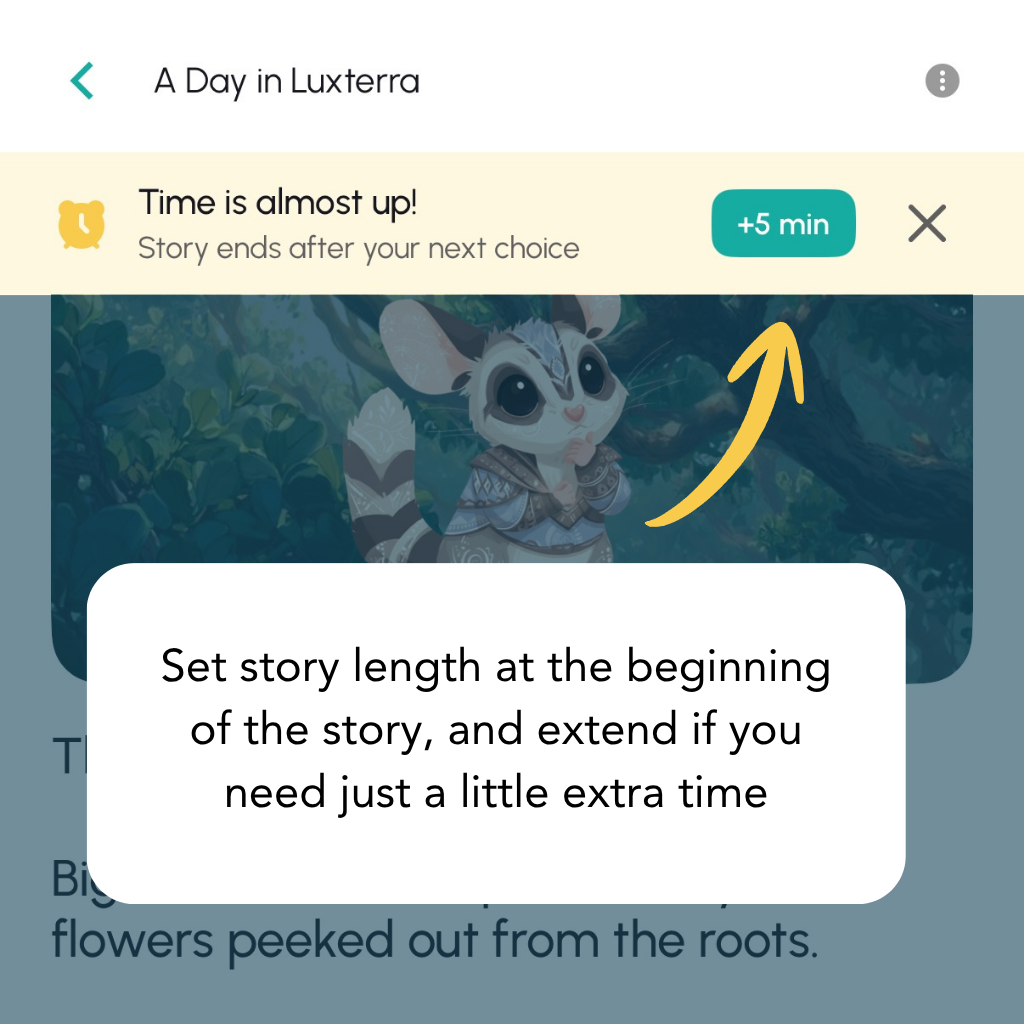
There’s no mode to pick. Your child guides the story toward what they need that night: pure play, something heavier, or a mix of both in the same session. As the caregiver, your job is just to be ready to receive whichever way it goes.
1 of 2
Some nights they just want to be the boss of the plot: making choices and watching them matter, going somewhere silly, having you along for the ride. What they’re getting isn’t trivial: they’re practicing being listened to, co-regulating with you in a low-stakes space, and building the quiet confidence that their ideas are worth following.
2 of 2
Other nights, often without warning, the story turns. A character gets left out, scared, or quiet. Your child might be processing something specific, or just exploring a feeling they’ve been carrying. These two things can happen in the same story. A silly llama adventure can take a quiet turn and come back again. (For what to do in those moments, see “When something feels heavier” below.)
You might see your child return to the same theme for several nights in a row. That’s normal, and usually a good sign. Kids often work through something by playing it again and again, gradually gaining mastery over it. They may eventually rewrite the ending, or simply stop returning to it.
These are invitations, not instructions. Pick whichever ones feel natural.
That’s normal, especially the first time. You can sit in the pause with them. Try: “It’s hard to come up with a story idea. Sometimes I have to think for a while too. I trust you’ll come up with something.” If they’re really stuck, offer two or three options. The pause itself is doing something.
Go with it. Say the weird sound. Laugh. Receive it. The point isn’t a coherent plot; it’s that they made something and you met them there.
Sometimes the story takes a turn. A character gets left out, or hurt, or quiet. You don’t need to fix it, and you don’t always need to be the one to name what’s happening either. The story itself will often wonder about the feeling or gently ask. If you do want to say something, you can reflect what your child said (“Wow, the dragon is really angry”) or validate the feeling (“That sounds like a hard feeling”). Big feelings often travel safer through a character than straight through a kid. If the same heavy theme keeps surfacing night after night, that’s worth paying attention to. These stories aren’t a substitute for professional support. If something keeps coming up, it might be time to mention it to your child’s pediatrician or a therapist who works with young children.
You can say very little. Your attention is doing most of the work. Children’s nervous systems regulate against the calm, present adults around them. You don’t have to perform; you just have to be there.
Come play with your favorite racers! Where will the day take you? Maybe you'll explore fun places, visit a friend's home, or head into Thimblewood forest. It's up to you to decide!

Create an open-ended story that supports and affirms your child's imagination. It's up to them to figure out what happens next!

Bring your own magic to this open-ended adventure in Luxterra! Where will the day take you? It's up to you to decide!