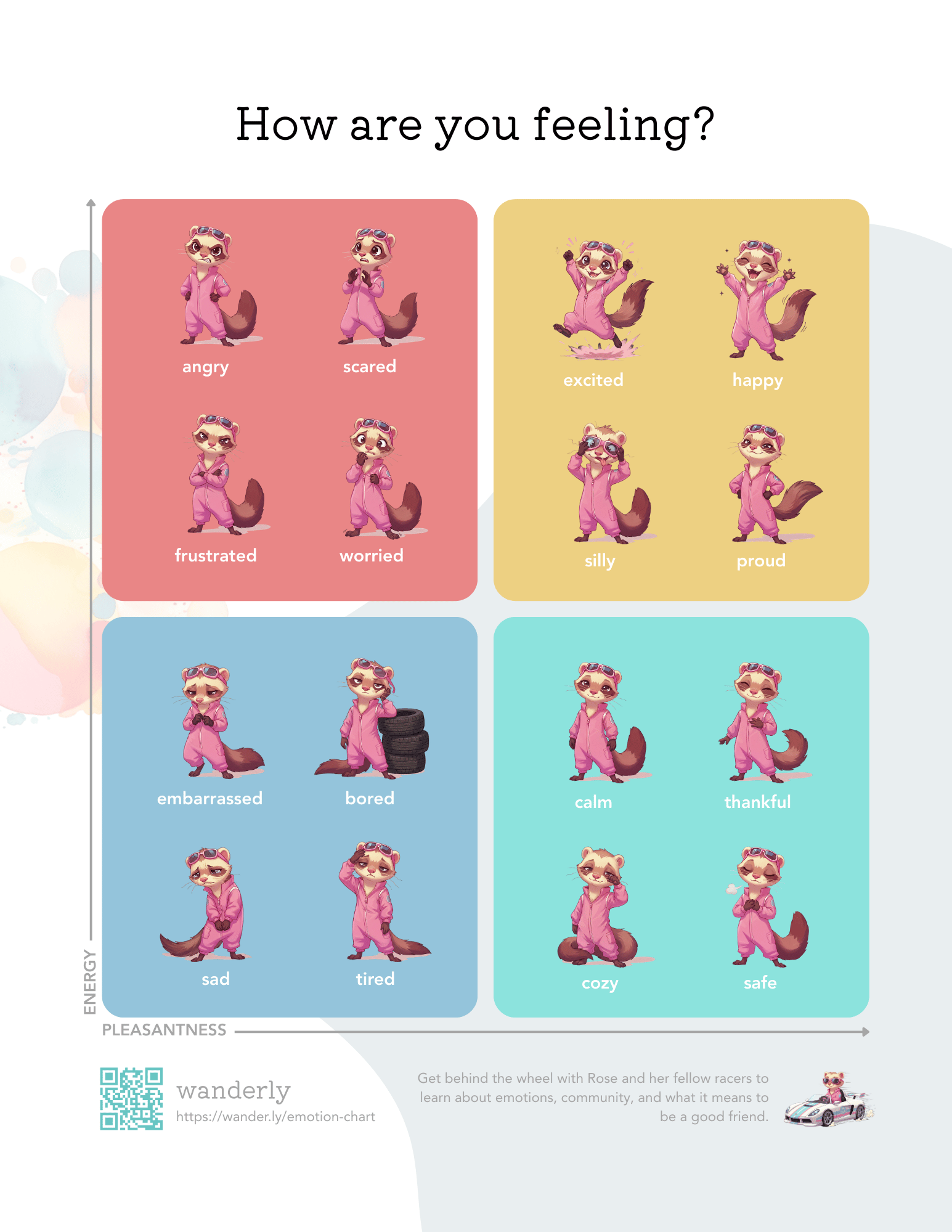

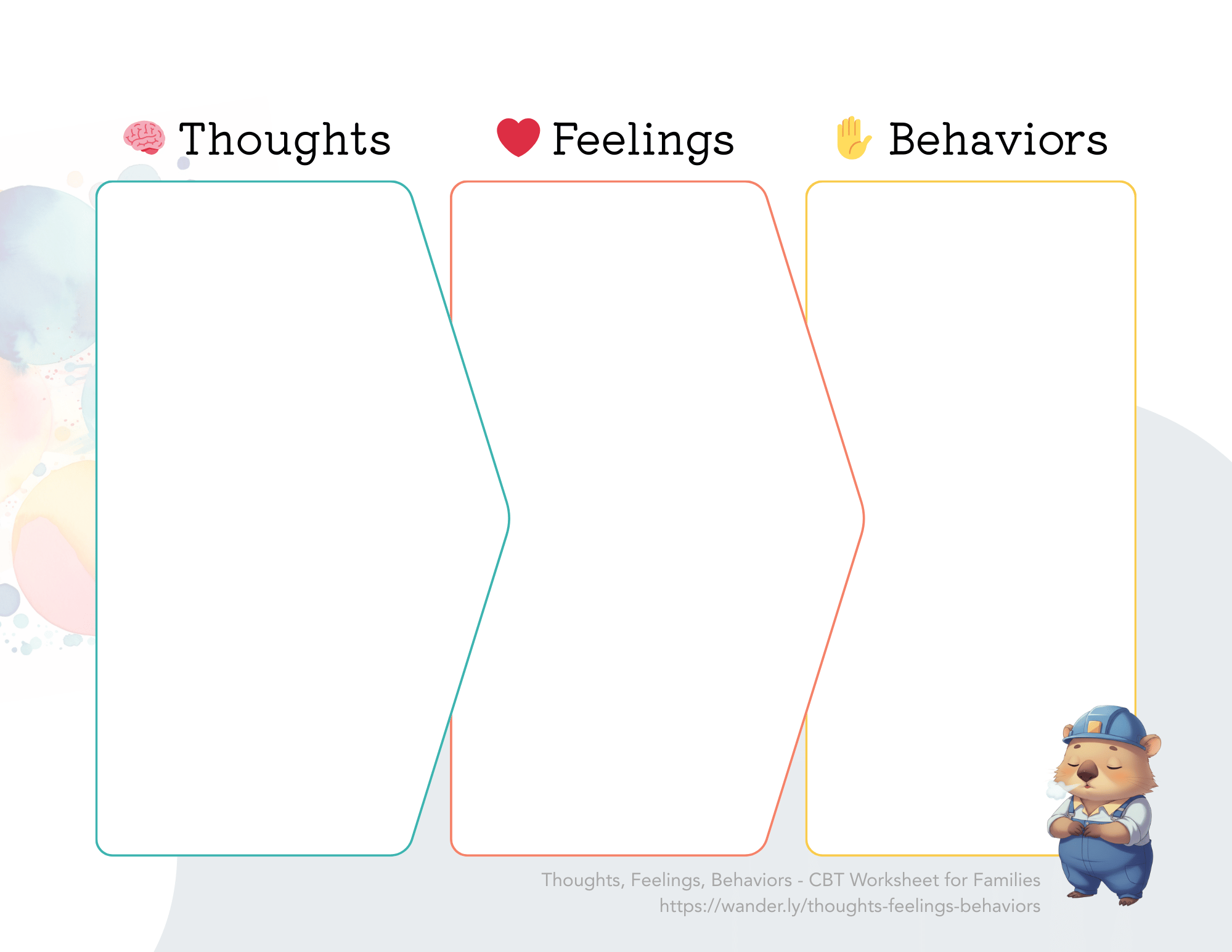
Thoughts, Feelings, Behaviors
CBT Worksheet for Families
A guided worksheet that helps children — with a parent's support — break down a difficult moment into three parts: what they were thinking, what they were feeling, and what they did. Based on the CBT cognitive triangle, one of the most evidence-backed tools in child psychology.
- Based on Beck's cognitive triangle (CBT)
- Adapted for children ages 5–12
- Helps separate thoughts from feelings from actions
- Best used after a difficult moment has passed
- Designed for parent and child to fill out together
Enter your email to download
We'll also send new free worksheets straight to your inbox as we make them.
The psychology behind it
The cognitive triangle — Aaron Beck, 1960s
Cognitive Behavioral Therapy (CBT) is built on a deceptively simple insight: thoughts, feelings, and behaviors are not separate — they influence each other in a continuous loop. This worksheet makes that loop visible.
Aaron Beck developed CBT in the 1960s while working with patients with depression. He observed that distress wasn't caused purely by circumstances — it was driven by how people interpreted those circumstances. A thought like “nobody likes me” produces a feeling like sadness, which leads to a behavior like withdrawing, which produces evidence that confirms the original thought. The loop tightens.
The arrows on this worksheet represent exactly that chain. They point forward — thought → feeling → behavior — but in practice the loop runs in all directions. Changing the thought can change the feeling. Changing the behavior (doing something different) can produce a new feeling that leads to a new thought. This is the mechanism that makes CBT one of the most studied and replicated psychotherapies in the world.
When adapted for children — sometimes called CBT-C — the approach becomes more concrete, collaborative, and story-based. Rather than examining abstract beliefs, child-adapted CBT works with specific situations: what happened, what the child thought, how they felt, and what they did. That's exactly what this worksheet asks. It's evidence-backed in its approach to childhood anxiety, depression, OCD, ADHD, and behavioral challenges, and is widely used by school counselors and child therapists as a starting point for reflective conversation.
How to use it with your child
Wait for calm before starting. This worksheet is most useful after a difficult moment has passed — not during it. When emotions are still high, the reflective thinking needed to fill it in isn't accessible yet. Give it 20–30 minutes, or even wait until the next day.
Be curious, not corrective. Approach it like a detective game: “I wonder what was going through your head when that happened?” rather than “What were you thinking?” with a frustrated tone. The goal is to help your child notice the connection between their inner experience and their actions — not to assign blame.
Fill in the arrows. The arrows between the three columns are important. After filling in each box, ask: “And when you had that thought, what did you feel?” and “And when you felt that, what did you do?” This makes the chain explicit and is where the real learning happens.
Introduce alternative thoughts gently. Once the chain is visible, you can ask: “What's another way to think about it?” or “What would you say to a friend who had that thought?” Don't force this step — even just completing the three boxes builds self-awareness that matters.
Keep previous worksheets. Over time, a collection of completed worksheets becomes a record of your child's patterns — the recurring thoughts that tend to show up, and the situations that trigger them. This is valuable information, both for you and for any professional who might be supporting your child.
A tip from Laura, Wanderly's founder
Once I started learning about the cognitive triangle, I tried an experiment: instead of asking my seven-year-old “what are you feeling?” after a hard moment, I started asking “what are your thoughts?”
I was surprised by two things. First, how much easier it was for her to answer. Children can often name a thought more concretely than a feeling. Second, the thoughts themselves. “I thought she was laughing at me.” “I thought if I didn't win, it meant I wasn't good at it.” “I thought you were mad at me too.” I would never have guessed any of those.
It flips the script in a useful way. Once you know the thought, the feeling makes complete sense, and so does the behavior. More often than not, the thought turned out to be a misunderstanding. Something that took two sentences to gently untangle once I knew it was there.
What to watch for
If completing this worksheet consistently causes your child significant distress — if they can't separate thoughts from feelings, become very upset revisiting the situation, or the same negative thought pattern appears repeatedly across many different situations — that's a signal to seek support from a child therapist. The worksheet is an educational tool for self-reflection; it's not a substitute for professional CBT, which involves trained guidance through the full therapeutic process. A pediatrician, school counselor, or therapist can help you identify whether a more structured intervention would be beneficial.
Take it further in the app
Wanderly stories help children practice recognizing their own thoughts and choosing different responses — in the safe, low-stakes context of storytelling. Browse stories that build these cognitive skills: